The Three Saints of Printing: Meeting Canna & FVAN

As some readers may know, I am currently conducting research on the history of the MARKK’s collection of industrially produced, popular Chinese prints of the 1920s and 30s. I understand these as “modern traditional prints,” since they combine the imagery of “traditional” Chinese woodblock prints with industrialized methods of production and a mass-media circulation. Below is an example of the god Guangong, accompanied by his youthful retainer Guan Ping and the dark-faced weapon bearer Zhou Cang, printed around 1932 by the Shanghai Global Picture Slip Company (Shanghai huanqiu huapian gongsi 上海環球畫片公司). In 1932, the ethnologist Theodor Danzel brought it from China to Hamburg, to serve as a representation of “traditional” Chinese culture that was assumed to be in the process of disappearing.

Guan Yu, San ren Guangong 三人關公; China, before 1932; Inv. Nr. 35.59:155; © MARKK, Bernd Spyra.

Starting from my engagement with prints like these, I also became interested in contemporary Chinese print culture—to the extent that it still exists at all, amid Weixin and Taobao and the widespread shift of popular culture into the digital realm. Speaking of Taobao: Especially before the Chinese New Year, industrially produced prints of gods can still be purchased, which in some places are still used to decorate front doors during the Holiday. An example of one I purchased, in a Hamburg Asian supermarket of all places, in 2025, can be seen here.

Door God Qin Shubao 秦叔宝 (one of a pair of two gods) bought in early 2025 at an Asian supermarket in Hamburg.

Colleagues with a traditionalist bent dismiss such prints as unworthy of consideration, since they are seemingly not an expression of artistic skill and are therefore “not beautiful.” Thus, patterns of reasoning from the late 19th and early 20th centuries are reproduced with astonishing accuracy—patterns that led precisely to such prints becoming the subject of ethnology and folklore studies, rather than East Asian art history, which for the longest time was preoccupied with conceptions of high culture. Nevertheless, I, too, became curious: Can you still find prints in today’s China that—despite all the upheavals of the 20th century—show traces of the traditional repertoire and combine this with artistic originality and creativity?

Canna & FVAN in their studio. Drying racks for prints on the left.

Turns out, yes you can. On April 4, I had the opportunity to visit the studio of artist couple Canna & FVAN, who are part of a wave of Shanghai artists working in the affordable, popular medium of screen printing. Their prints feature (among many other motifs) figures from the Chinese narrative tradition and the popular religious pantheon, and are sometimes created by the duo for specific occasions such as the New Year with its change of the zodiac signs, while utilizing traditional expressive techniques such as the pictorial representation of homophones.

One example of this is Canna’s print of a squirrel (松鼠 songshu) among the branches and cones of a pine tree (松树 songshu). These two are not only connected in nature, with squirrels living in pine trees and feeding on their seeds, but also through their almost identical pronunciation in Chinese. Such homophones were used to set up pictorial puns that work by showing one thing in order to allude to another through the shared pronunciation, which is a subversive form of expression with a long history in Chinese visual culture. As already noted by Jiang Yanwen, usage of these homophones is a typical characteristic of popular Chinese prints.

Songshu as a non-traditional usage of homophones.

Here, however, both songshu unusually appear together in the same image, which removes the original purpose of the homophone. This is particularly interesting since the two motifs traditionally carry rather different associations: the pine tree stands for endurance and longevity, while the squirrel evokes liveliness, vitality, and abundance. In Canna’s version, both meanings are brought together in one striking image.

The studio with beckoning cat (on the table in background), the screen exposure unit (center) and the screen printing press (right).

Besides working on traditional forms and content, however, Canna and FVAN engage with the realities of urban life in Shanghai, using vibrant neon colors that even glow under UV light, a hallmark of the technique of screen printing. In addition to its striking colors, the technique is furthermore now closely associated with the Pop Art produced by Andy Warhol in the “Factory” (think of soup cans). Unlike collectors at the beginning of the 20th century, however, no one would now think of these works “not Chinese” enough for that reason.

Three saints of printing: Andy Warhol, Lu Ban and Lu Xun.

On the contrary: In their art, Canna & FVAN synthesize influences on Chinese printmaking and the very realities of life that can no longer be simply distinguished as “Chinese” and “European.” We see this particularly clearly in the above print by FVAN, which appears to reflect on the influences shaping their work:

At a workbench, the godfather of Pop Art, Andy Warhol, works on a screen-printing frame, while next to him Lu Ban, the Chinese patron god of carpenters and woodworkers, cuts a woodblock printing plate. Both of them are printing the same motif—an image-within-an-image of the whole print we see before us. Standing behind them, the intellectual Lu Xun—one of the earliest advocates for the modernization and politicization of Chinese printmaking—with his signature piercing gaze scrutinizes the same image in his hands, just like we are doing as the viewers of the work. Finally, standing between the three is Dobby, a house-elf from the Harry Potter universe, which took China by storm as a global youth phenomenon in the late 90s and early 2000s. The universe’s characters, particularly their film versions, were repurposed as memes by the Chinese fan community and thus developed a life of their own that transcends a positioning between Western production and Chinese reception.

The punchline of it all, which hits us right between the eyes, reminds us that the work exists not only within historical trajectories and genealogies: Andy Warhol’s T-shirt bears a quote attributed to the artist Guy James Whitworth: “Buy Art From Living Artists. The Dead Ones Don’t Need The Money.”

In this case, I can say I did: The print of the three patron saints of printing has found a place in my collection—in Hamburg.

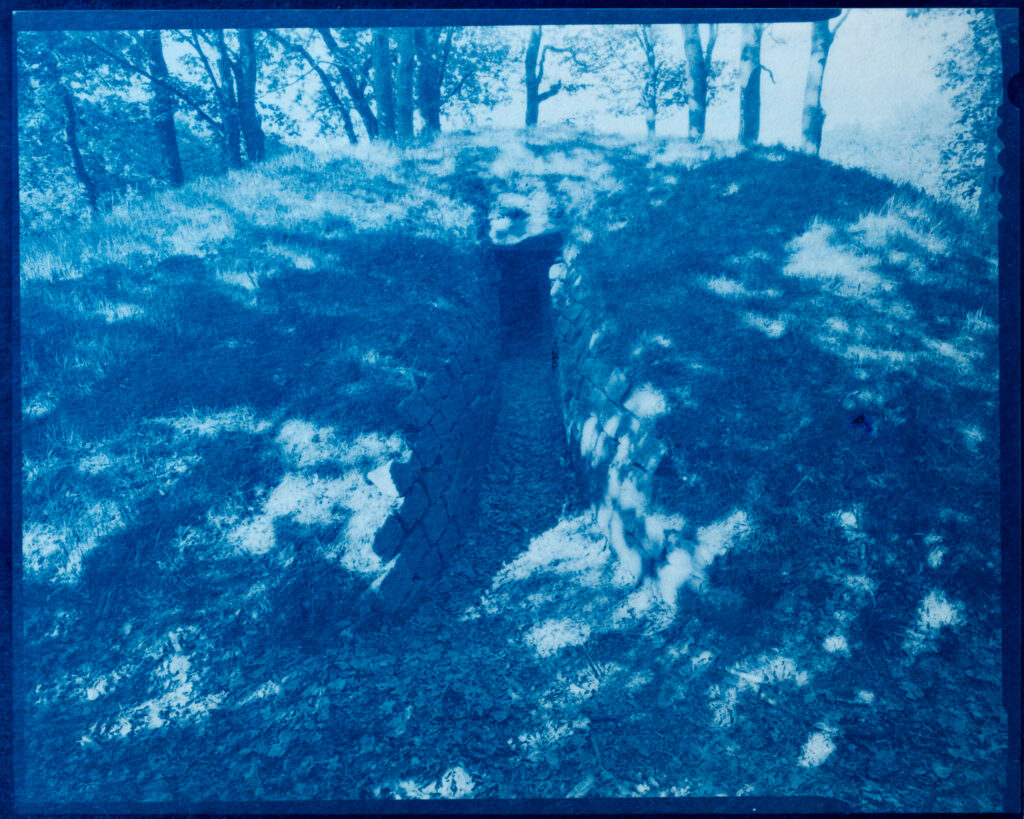
Kind of blue

Linden-Pahlkrug, 11.05.2025.

Happy New Year everyone! Since it’s gotten a bit too silent around here lately, I want to share some strictly work in progress. Over the last year, I began experimenting with the cyanotype process, as well as with large-format photography. I combine both to create images of Stone and Bronze Age burial mounds and megalithic structures in Germany’s northernmost state of Schleswig-Holstein. These images are scans of cyanotype contact prints made from 4×5 negatives.

postchristmas goes Kiel

Pünktlich zur Vorweihnachtszeit war es auch wieder Zeit für Postchristmas: Fotos von Weihnachtsbäumen nach Weihnachten, zusammen mit Texten von meinem Bruder Frank. Design wie alle Jahre wieder von Sternstunden des Kapitalismus.

Ausstellungseröffnung und Lesung am Sa. 29.11.2025, 19:00h im K34 in der Medusastraße 14, Kiel.

Am 29.11.2025 erschien in den Kieler Nachrichten ein Artikel über die Ausstellung (paywall).

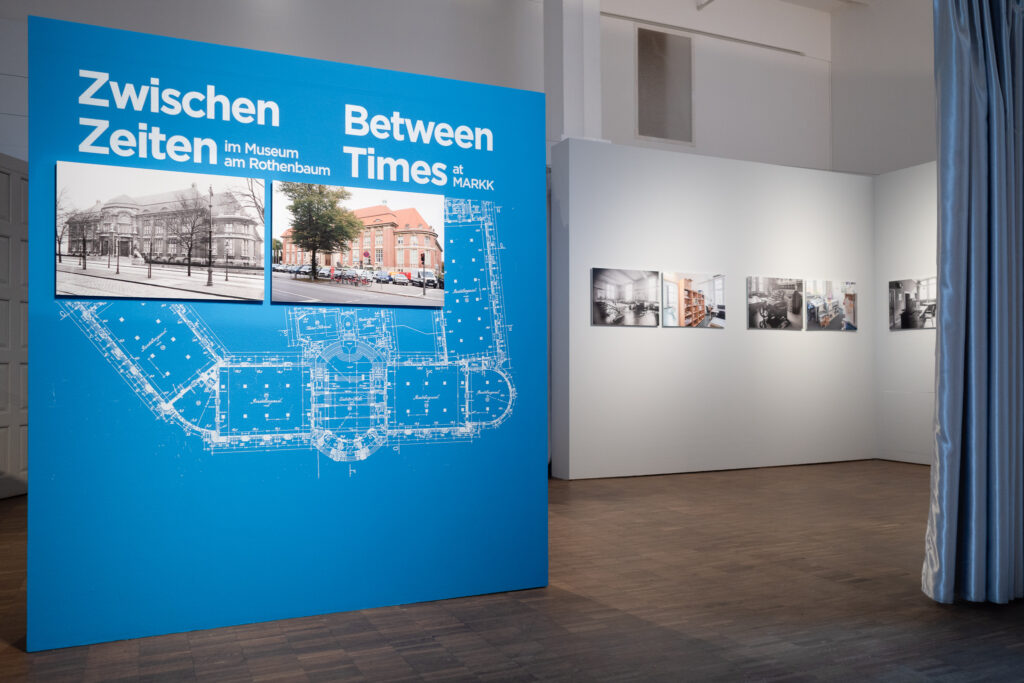
Zwischen Zeiten im Museum am Rothenbaum // Between Times at MARKK

Ausstellung // Exhibition 14.10.2025 – 15.01.2026

Unter dem Titel Zwischen Zeiten im Museum am Rothenbaum wird mein Refotografie-Projekt historischer Museumsaufnahmen MARKK in Time seit Mitte Oktober im MARKK ausgestellt. Die Präsentation umfasst neben der eigentlichen Ausstellung im Zwischenraum auch QR-Codes in verschiedenen Räumen des Museums, welche die Besucher:innen zu weiteren historischen Ansichten und deren Refotografien führen.

Weiter unten sind ein paar Eindrücke der Ausstellung zu sehen, die ich zusammen mit Catharina Winzer (Leiterin Fotografische Sammlung MARKK) und Gabriel Schimmeroth (Leitung Veranstaltungen und Kurator Zwischenraum) kuratiert habe. Neben den Bildpaaren der historischen Fotografien und Refotografien informiert eine Vitrine über die Arbeit der Fotografinnen, die im Rahmen ihrer Arbeit in der hauseigenen Lichtbildnerei in den 1910er Jahren die historischen Fotografien angefertigt hatten.

//

Under the title “Between Times at MARKK”, my rephotography project of historical museum photographs, MARKK in Time, has been on display at MARKK since mid-October. In addition to the actual exhibition in the “Space Between“, the presentation also includes QR-codes in various rooms of the museum, which lead visitors to further historical views and their re-photographs.

Below are a few impressions of the exhibition, which I curated together with Catharina Winzer (head of the MARKK photographic collection) and Gabriel Schimmeroth (head of events and curator of Zwischenraum). In addition to the pairs of historical photographs and re-photographs, a display case provides information about the work of the photographers who produced the historical photos in the 1910s as part of their work in the museum’s own photo studio.

Am 28.10.2025 erschien in den Eimsbütteler Nachrichten ein Artikel über die Ausstellung (paywall).

Kukumba My Lord – Dill With It 8

Gruppenausstellung von Gurkenkunst im Nachladen (Sternstraße 17, Hamburg), 06.09.–04.10.2025

MARKK in Time

Es ist vollbracht: Am 21.08.2024 wurde mein Refotografie-Projekt „MARKK in Time“ historisch, als es unter den Inventarnummern 2024.4:1-75 in die fotografische Sammlung des Museums am Rothenbaum aufgenommen wurde. Obwohl eine mit dem MARKK abgestimmte Veröffentlichung noch nicht erfolgt ist, kann die Recherche- und Fotoarbeit, die in enger Zusammenarbeit mit dem Haus und insbesondre Catharina Winzer (Leiterin der fotografischen Sammlung), durchgeführt wurde, damit als abgeschlossen betrachtet werden. Ich möchte dies zum Anlass nehmen, das Projekt hier kurz zusammenzufassen.

Übergabe der Projektergebnisse an Catharina Winzer, Leiterin der fotografischen Sammlung im MARKK, am 21.08.2024. © Museum am Rothenbaum (MARKK), Hamburg, Foto: Paul Schimweg.

Idee

Der eigentliche Grund, weshalb ich seit einiger Zeit im und am MARKK unterwegs bin, ist die Durchführung meines Forschungsprojekts zu den populären chinesischen Drucken des frühen 20. Jahrhunderts, welche sich in der Sammlung des Hauses befinden. Im Zuge der Arbeit am Projekt habe ich auch die Bestände des Fotoarchivs nach Spuren der historischen Beschäftigung mit chinesischen Objekten durchsucht, und bin dabei auf einige Glasnegative mit Innenansichten des Museums gestoßen, auf denen chinesische Objekte zu erkennen sind. Ein Beispiel ist unten zu sehen.

Chinesischer Druck im Ostasien-Saal, 1910er. Inv. Nr. Mus 67. © Museum am Rothenbaum (MARKK), Hamburg.

Dieses Foto stammt aus einer großangelegten Serie, welche die Fotografinnen des Hauses zur Dokumentation des Museumsneubaus in den späten 1910er Jahren angefertigt hatten. Zahlreiche Fotos aus dieser Serie wurden dann zur Illustration von Georg Thilenius 1916 erschienener Publikation Das Hamburgische Museum für Völkerkunde verwendet, wo sie den Museumsbetrieb in den eigens dafür geschaffenen Räumlichkeiten zeigen. Im Rahmen meiner Forschung im Haus wurde mir bewusst, wie viele von den historischen Szenen heute — nach über 100 Jahren — noch immer erkennbar sind, und wie stark die Umstände der jetzigen Arbeit im Haus sowohl im Guten wie im Schlechten noch immer auf die Neubauzeit verweisen.

Im Jahr 2022 wurden dem Museum die Mittel für eine umfassende Modernisierung bewilligt. Damit wird auch die jetzige Form des Hauses in absehbarer Zeit historisch werden, indem sie von neuen baulichen Ansätzen, die wiederum neuen musealen Ansätzen dienen, ersetzt wird. Höchste Zeit also, den jetzigen Zustand in seiner historisch gewachsenen Form zu dokumentieren, bevor er nicht mehr sichtbar ist. Da mir dies durch den bestehenden Zugang zum Haus möglich ist, war es eine Gelegenheit, die ich nicht verstreichen lassen konnte.

Umsetzung

Die erwähnten fotografischen Innenansichten des Hauses, welche die Arbeits- und Sichtweisen der historischen Ethnologie dokumentieren, stellen ein ideales Ausgangsmaterial für ein künstlerisches Refotografie-Projekt dar:

Die Refotografie visualisiert als Methode räumliche und zeitliche Beziehungen. Sie ist damit sowohl eng „verwandt“ mit der Fotogrammmetrie und Stereofotografie, als auch mit der klassischen Kinematographie (‚Bewegungsaufzeichnung‘ durch Aufnahme mehrerer, zeitlich versetzter Einzelbilder) und ihren auf Zeitverhältnissen konzentrierten Formen Zeitraffer und Zeitlupe. Die Methode ist momentan nicht nur äußerst populär, in der Durchführung ist sie außerdem vergleichsweise simpel, wenngleich gute Ergebnisse eine hohe Präzision erfordern: Der genaue Aufnahmestandpunkt eines historischen Fotos wird bestimmt, von diesem Standpunkt aus wird der Gegenstand erneut („re“)-fotografiert.

In diesem Projekt werden die erneuten Aufnahmen der gezeigten Orte im heutigen Museum den alten Aufnahmen mit dem Ziel gegenübergestellt, die Problematiken der historischen, ethnologischen Arbeitsweise für die Museumsbesucher:innen zum einen erfahrbar zu machen und zum andern auf visuelle Weise aufzuheben. Dies geschieht, indem die originäre Perspektive zeitlich multipliziert und damit kontingent gesetzt wird. Gleichzeitig wird der Ist-Zustand des Hauses vor dem Umbau in seinem historischen Kontext dokumentiert.

Als Korpus — mit begleitendem und erklärenden Text — erlauben die insgesamt 75 Aufnahmen, die Arbeitsprozesse in einem klassischen ethnologischen Museum nachzuvollziehen, wobei die Verarbeitung als Refotografien nicht nur die jeweiligen Bildinhalte historisiert und relativiert, sondern auch den Betrachter:innen erlaubt, den jetzigen Ist-Zustand in seiner Zeitlichkeit zu begreifen.

Durch die Aufnahme in die fotografische Sammlung sind die Fotos nun zu einem Teil des MARKK geworden, einem Teil des MARKK in der Zeit.